
食品添加剂供应商 (公司)

MSG Production: Process, Standards, and Quality Assurance

Mar 31, 2026

Modern MSG production is dominated by microbial fermentation (over 90% globally), a highly efficient, food-safe process that converts starch or sugar into high-purity monosodium glutamate (≥99%) under strict ISO, GMP, and HACCP controls. This method ensures consistent quality, compliance with international food safety standards, and alignment with global market demands.

Core Production Process

MSG production follows a standardized, four-stage workflow optimized for yield and purity:

Raw Material Preparation

Primary feedstocks are corn starch (82% of global use), tapioca, or molasses. Starch is mixed with water (1:3 ratio) to form a 30–35% slurry, then liquefied with α-amylase at 80–100°C for 30–60 minutes. The resulting dextrin is saccharified with glucoamylase at 55–60°C for 12–24 hours to produce glucose, the primary carbon source for fermentation.

Fermentation

Glucose is fed into bioreactors with Corynebacterium glutamicum, a GRAS (Generally Recognized as Safe) bacterium. Under controlled conditions (30–34°C, pH 7.0–7.4, dissolved oxygen >30%), the bacteria convert glucose into L-glutamic acid over 36–48 hours. Leading producers achieve sugar-to-acid conversion rates of 58–64.5%, near the theoretical maximum of 62%.

Extraction & Purification

Fermentation broth is filtered to remove biomass. Glutamic acid is isolated via isoelectric point crystallization (pH 3.2), centrifuged, and washed. It is then neutralized with food-grade sodium hydroxide to form MSG solution, which undergoes activated carbon decolorization and ion-exchange filtration to remove impurities.

Crystallization, Drying & Packaging

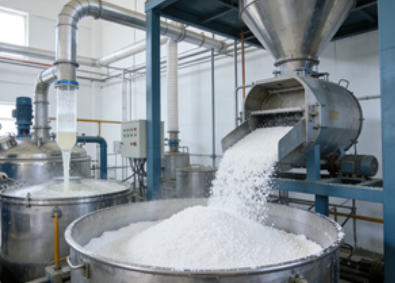
Purified MSG solution is concentrated and crystallized. Crystals are dried to a moisture content ≤0.5% (per GB 2720-2015) and milled to 20–80 mesh. Final products are tested for purity, heavy metals, and microbial load before packaging under ISO 22000 conditions.

Industry Standards & Certifications

MSG production adheres to rigorous global and national standards to ensure safety and quality:

ISO 22000: Food safety management system integrating HACCP and GMP, mandatory for global food ingredient supply chains.

ISO 5498:1981: International method for MSG purity analysis, ensuring ≥99% L-glutamate monosodium content.

GB 2720-2015 (China): Mandatory standard defining MSG classification, sensory properties, and heavy metal limits (e.g., lead ≤1 mg/kg).

GB/T 8967-2007: Specifies technical parameters including moisture, pH, and particle size.

SGS/FDA/HALAL/KOSHER: Third-party certifications verifying compliance with global regulatory and religious requirements.

Global Production Landscape

Asia accounts for 94% of global MSG capacity, with China as the largest producer (78% of 2024 output, ~2.75 million metric tons). Top manufacturers (Fufeng Group, Meihua Bio-tech) control 65% of global capacity, leveraging advanced fermentation and automation to reduce energy use by 28% over the past decade. High-purity (≥99%) and compound MSG (with I+G) now represent 38.6% of the market, driven by food industry demand for clean-label, high-performance flavor enhancers.

Quality Control & Sustainability

Modern plants implement real-time monitoring of fermentation parameters, with SGS-certified labs testing every batch for purity, contaminants, and compliance. Sustainable practices include wastewater treatment, energy recovery, and strain optimization via CRISPR-Cas9 to reduce byproducts by 40%.

FAQ

Is MSG production natural?

Yes — modern MSG is made via microbial fermentation, similar to yogurt or wine, using natural raw materials and food-safe bacteria.

What purity levels are standard for food-grade MSG?

Food-grade MSG must contain ≥99% monosodium glutamate (per ISO 5498 and GB 2720-2015), with moisture ≤0.5%.

What certifications are required for global MSG trade?

Key certifications include ISO 22000, HACCP, FDA, HALAL, KOSHER, and SGS testing reports to meet import regulations.

How long is the full MSG production cycle?

The complete process — from raw material to packaged product — takes 4–5 days, with fermentation accounting for 36–48 hours.

Is MSG production environmentally sustainable?

Leading facilities use closed-loop systems, energy recovery, and low-waste fermentation, cutting unit energy consumption by approximately 28% in the past decade.

If you want to know more about MSG, please contact us at GNF. We will be more than happy to serve you.

Food Additives Monosodium Glutamate 99%


需要帮忙?与我们聊天

留言
如果您对我们的产品感兴趣并想了解更多详情,请在此留言,我们会尽快回复您。
提交
寻找 接触
联系我们 #
+86 551 63500087

主页

产品

WhatsApp

接触

Start a Conversation

Hi! Click one of our members below to chat on